
AI Content Creation, Minus the Robots: The 5-Point Framework for a Human Voice

Co-Founder / CTO
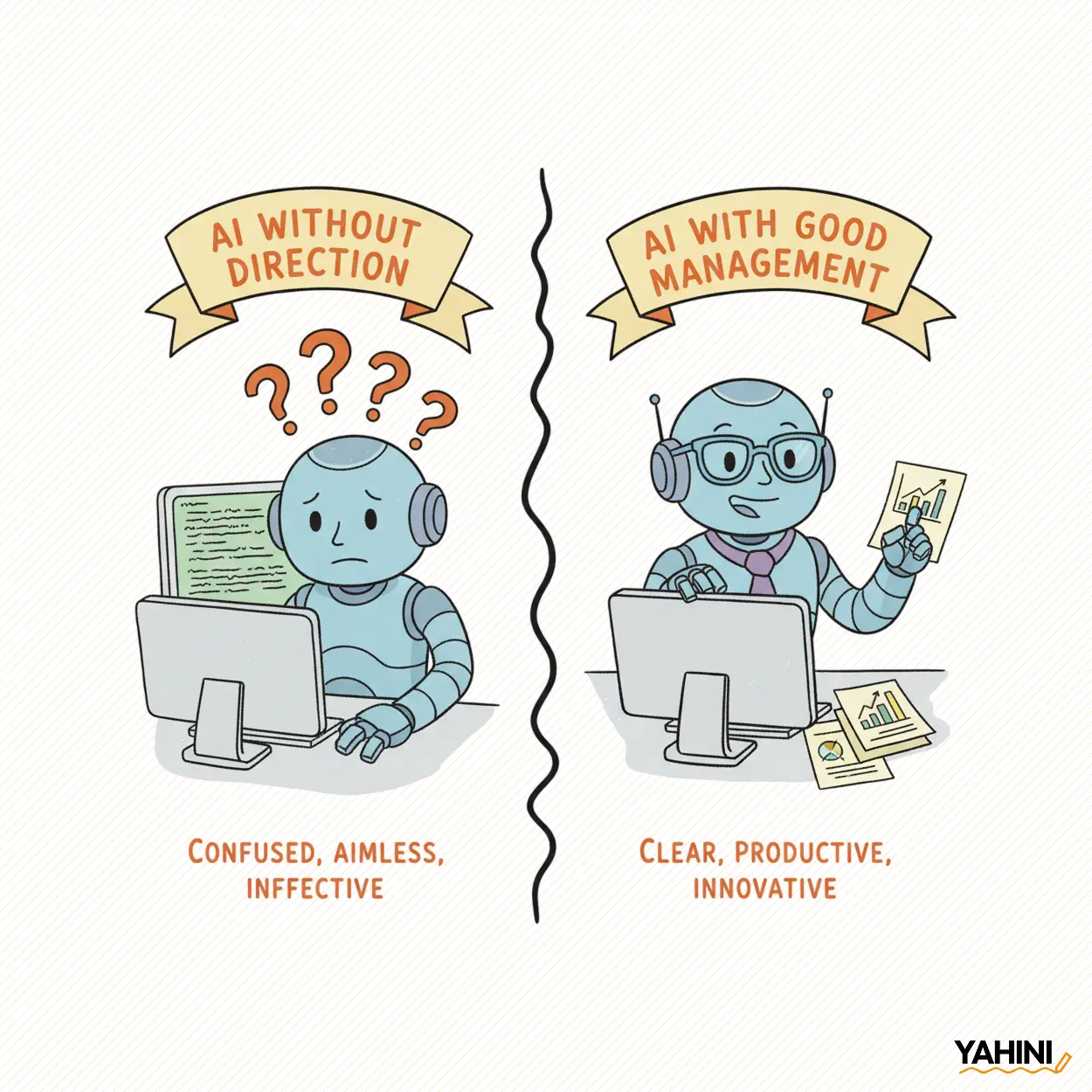
Most people think AI is for “writing faster.” That’s the conventional wisdom. But I learned the hard way that it's not just wrong, it’s dangerous. The problem is that we treat AI like a magic button, and in doing so, we generate soulless fluff that damages our brand. We should be treating it like a smart but clueless intern. It has all the processing power in the world, but zero business context.
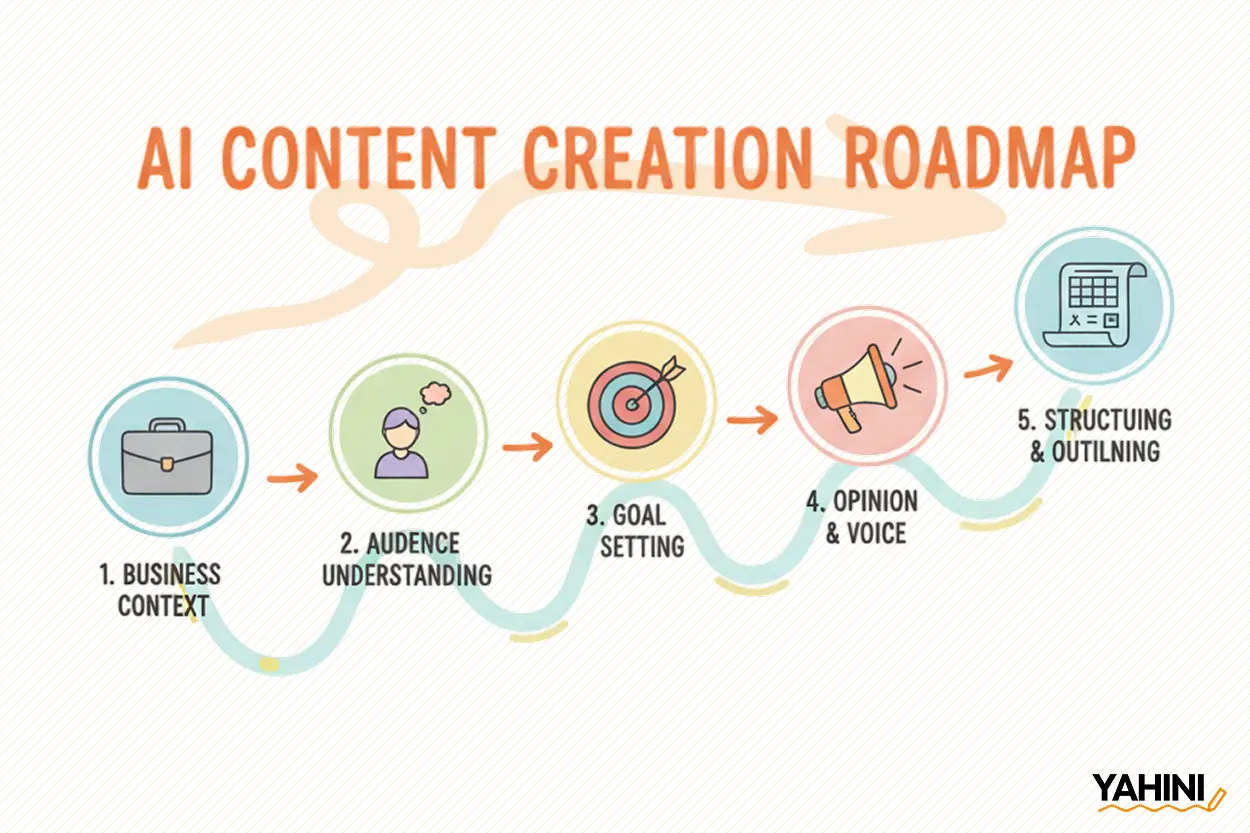
An intern needs a good manager. And a good manager provides a great brief. The quality of the work you get back from your AI intern depends entirely on the quality of your instructions.
I was so frustrated with the strategic chaos and wasted effort of my early failures that I developed a system. A way to “manage” the AI to make sure it had the strategic direction it needed to be useful. I'm sharing it because I see so many other founders hitting the same wall I did.
And to make it dead simple, I created a template called the AI Briefing Canvas. It's the exact tool I use to structure my thinking. You can grab it here.
The rest of this post is how I use it. No theory, just the five-step process that turned AI from a frustrating toy into a true strategic asset for me.
Table of Contents
1. First, teach the AI about your business
Before you ask an AI to write for you, you must first teach it who you are.
Assuming it knows anything about your business, your products, your value proposition, or your differentiators is a fatal error. Without this source material, it can only give you generic advice scraped from other people's websites.
You have to provide the foundational information that gives your business its identity. Think of it as the briefing you'd give a new marketing hire on their first day. It’s the core context that should inform every single thing you publish.
Get this down on paper:
-
What you sell: Be ruthlessly simple. One or two sentences. No marketing jargon. For example: “We are a subscription-based coffee delivery service for remote teams.” If you can't state it simply, the AI has no chance of understanding it.
-
Why you matter: What is the one core benefit a customer gets? This should be a single, powerful sentence. For example: “We help companies boost team morale and productivity by delivering high-quality, convenient coffee directly to employees' homes.”
-
How you’re different: List out the 2-3 concrete things that make your approach unique. This is where you hand the AI the language of your competitive advantage. Examples: “Ethically sourced beans from single-origin farms,” “Personalized coffee selections for each employee,” “A delivery radius that covers 95% of the metro area.”
This is foundational strategic work. But the real challenge is making sure this core context is consistently woven into every single piece of content, not just lost in a one-off document or a messy spreadsheet.
That constant struggle to maintain a single source of truth is why we built Yahini. Its Brand Intelligence profile to absorb this information once, acting as your brand's strategic foundation, so it can be automatically applied to every keyword you target and every brief you generate.
2. Next, tell it exactly who you're talking to
Your content will be generic if you write for a generic audience.
“Marketing managers” isn't an audience, but a demographic. To make the AI's output feel personal and resonant, you have to give it a vivid picture of the one person on the other side of the screen.
Good content makes a single person feel deeply seen and understood. You have to move beyond job titles and define their inner world. What are they secretly worried about at 2 a.m.? What does a “win” at work look like for them?
Now, build a mini-persona. Get specific:
-
Who they are: Give them a role and context. “A Head of People at a mid-stage tech company (50-200 employees) that has recently gone fully remote.”
-
What they hate: Describe their specific frustrations in their own words. “She's struggling to maintain a positive company culture without a central office. She hears complaints that remote employees feel disconnected. She's tired of managing dozens of small, inconsistent vendors for employee perks.”
-
What they want: Define their desired outcome. “She wants to be seen as a hero who is proactively building a great remote culture. She wants a simple, 'set-it-and-forget-it' solution that makes employees feel valued.”
Writing this down forces you to develop empathy.
When you feed this level of detail to an AI, it can finally adopt a tone and focus that speaks to their reality. All great marketing starts with a deep, almost obsessive, understanding of the customer's pain, and this empathy must be systematized to be effective at scale.
3. Give every single article one job to do
Let's be honest, you probably have “publish a blog post” on your to-do list. That's an activity, not a business goal. Content created without a clear purpose is just expensive noise. Every article, every landing page, every ad must have one specific job.
Is its job to attract people who don't even know they have a problem yet (Top of Funnel - TOFU)? Is it to help people who are actively comparing solutions (Middle of Funnel - MOFU)? Or is its job to persuade someone that your solution is the absolute best choice for them (Bottom of Funnel - BOFU)?
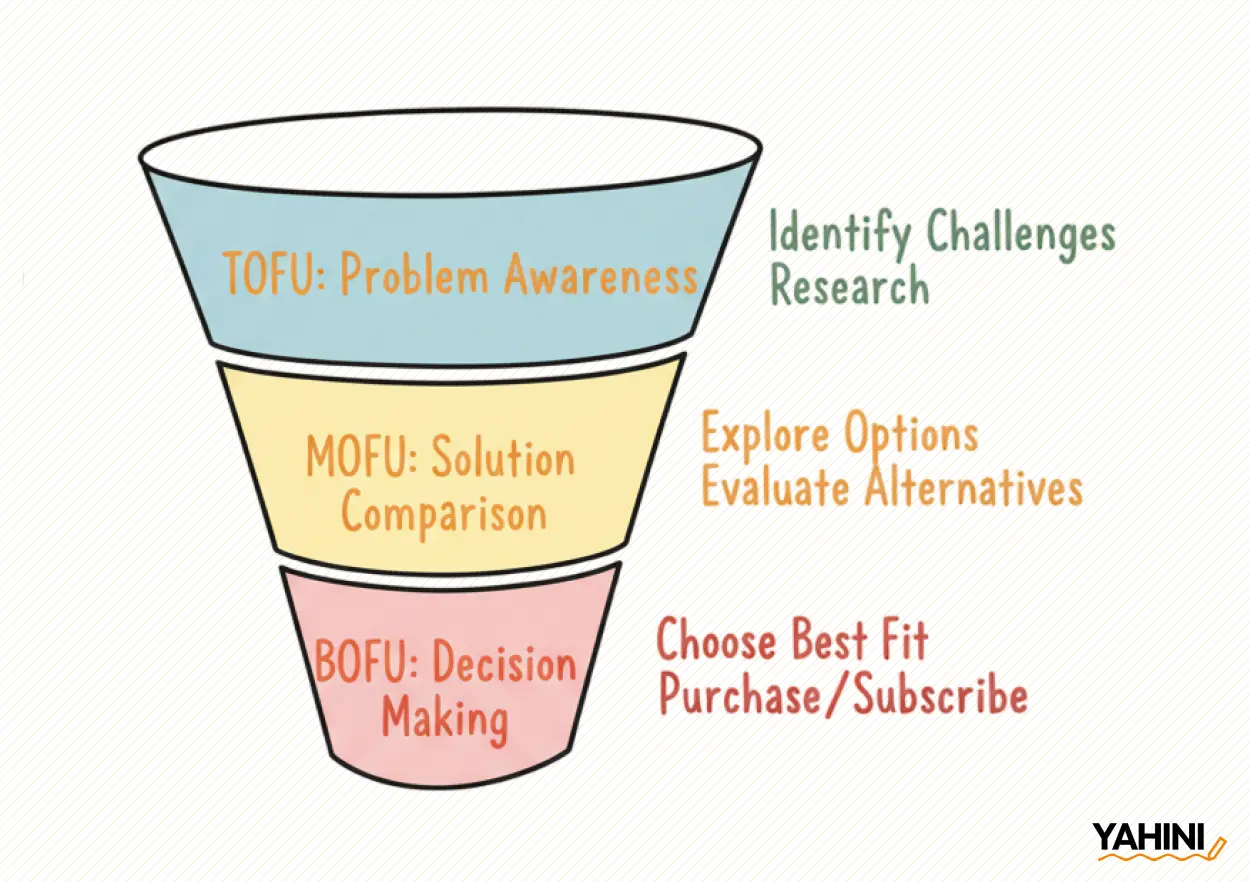
How many companies have you seen with a blog that's just a random assortment of posts? It's a content graveyard. It’s a perfect example of strategic chaos. There's no clear intent. Defining the goal dictates the article's structure, tone, and call to action.
Here’s how to define the job-to-be-done:
-
Funnel stage: Just pick one: TOFU, MOFU, or BOFU.
-
The next step: What is the single, tangible action you want the reader to take? Don't say “visit our website.” That's not a real action. Be specific. For a TOFU piece, it might be: “Download our 'Remote Culture Handbook'.” For a BOFU piece, it must be sharper: “Start a 14-day free trial.”
This simple choice changes everything. Manually mapping every keyword idea to a funnel stage is the thankless, yet absolutely critical, work of a content strategist. Because this process is so time-consuming yet so important, you can also use a platform like Yahini, whose funnel-aware keyword analysis automatically scores hundreds of keywords against funnel stages, giving you a prioritized content plan in minutes.
4. State your opinion loudly and clearly
Here’s a hard truth about AI models: they are built to be agreeable. They are statistical parrots trained on the entire internet to find the most common, average, consensus-based answer.
But the average answer is boring. Great content doesn't come from consensus.
What's a belief you hold that might make your competitors uncomfortable?
What's your “spiky” take on your industry? That's not just content; that's your intellectual property. The AI can’t invent it for you. You must provide the core argument.
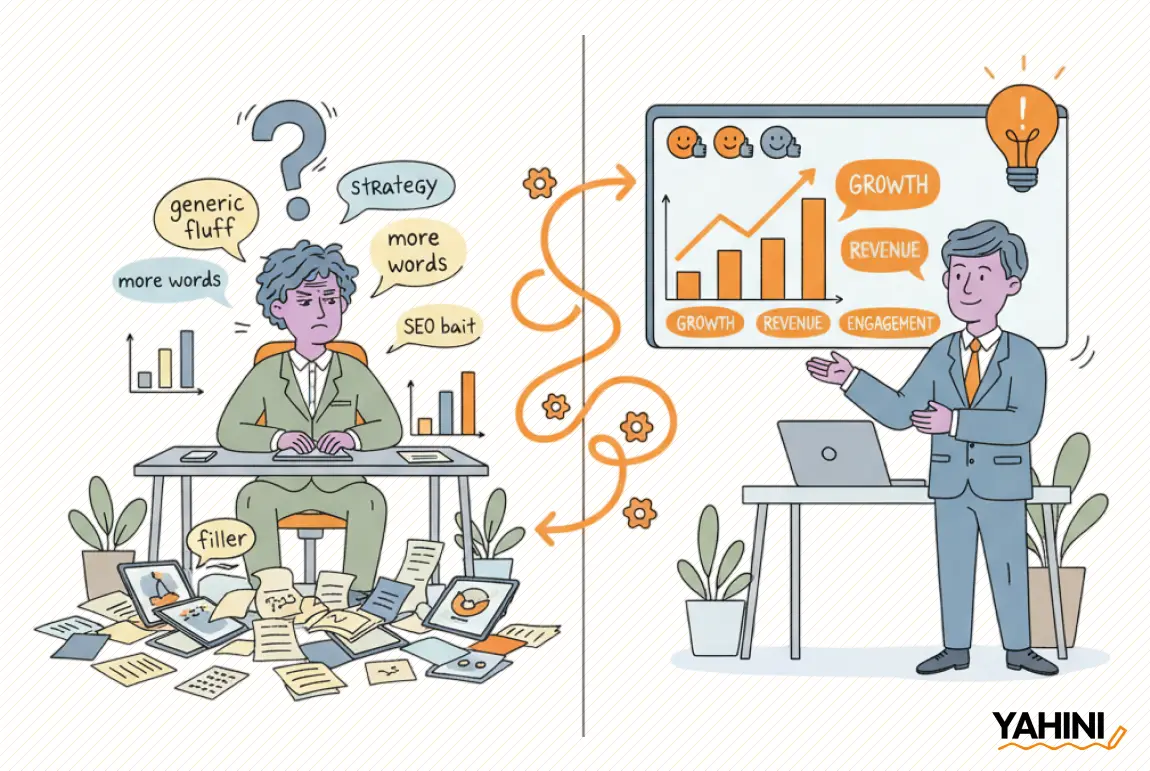
Codify your unique angle:
-
The thesis: State your central argument in one strong, declarative sentence. Example: “Stop wasting money on random office perks; the only thing that fuels every single workday is great coffee.”
-
Your proof: List 2-3 supporting points that back up your argument. “Daily coffee is a consistent cultural ritual, not a one-off event,” or “High-quality coffee has a measurable ROI in employee focus and productivity.”
An AI can't invent this for you. Your job as the founder is to provide the argument. The challenge is ensuring that crucial perspective is consistently woven into your content, not just lost in a one-off document.
5. Finally, give the AI a detailed structural outline
You're almost there. This is the final, most tactical step.
Never, ever ask an AI to “write an article about X.” That is an abdication of your role as a manager. You wouldn't tell a new team member, “Go build a presentation on Q3 performance,” and just walk away. You'd give them a structure, a narrative flow, and the key points to hit.
You must do the same for your AI intern. Providing a clear outline is what separates a structured, persuasive draft from a meandering mess. It's how you control the narrative and ensure the final piece accomplishes the strategic goal you already defined.
Your outline should be a simple blueprint:
-
Working headline: A clear, benefit-driven title.
-
The hook: How will you grab the reader in the first two sentences? State the problem.
-
Section headings: Write out the main H2s for the article. These are the pillars of your argument.
-
Key points: Under each H2, list the 2-3 main ideas, stats, or examples you want to include.
-
The conclusion: How will you summarize the core argument and drive home the call to action?
You can build these by hand for every article, or you can automate the process. For instance, Yahini's strategist-trained content briefs are designed to do this synthesis work for you, combining your business context, keyword goals, and audience focus to generate a detailed outline automatically.
Change is hard, but fluff is absolutely useless
Look, this is a process. It requires you to do some strategic thinking upfront. It forces you to shift from hoping for a magic button to actually managing a powerful tool. But it's the only way I've found to get real business results from AI.
Give this framework a try. Download the canvas to structure your own thinking. And when you're ready to automate the entire strategic workflow, you can start a free trial of Yahini and have a complete, prioritized content plan in minutes.
I'd love to hear how it goes. The conversation around AI is changing fast, and I'm always curious to learn from what others are finding works.