
A Better Keyword Strategy: The "Reverse Keyword" Framework

Co-Founder / CMO
I'm going to start with a brutal truth that I think about a lot. 96.55% of pages on the internet get zero traffic from Google.
Honestly, that number doesn't even surprise me anymore. It just explains the frustration I hear about constantly. This is the silent failure of modern SEO, with many companies struggling to get visibility on any search engine, AI included.
I know this feeling well because I've made the same mistake.
Early in my career, my team spent a quarter chasing the high-volume keyword "what is cloud computing." We published a brilliant article, or so I thought.
The problem wasn't our effort; our playbook was fundamentally backward. We dutifully started in a keyword tool, asking, "What keywords are popular?" This was our flawed version of keyword research. We should have been starting with a whiteboard, asking, "What keywords accurately describe the problems we solve for our best customers?"
This guide hands you the new playbook. And it’s a complete reversal of the traditional approach to keyword research. My goal here is to help you stop hunting for keywords and start by mapping your business reality.
We'll walk through the manual process step-by-step, because understanding this strategic thinking is key. It’s the very framework for a successful keyword strategy that we've spent years refining and ultimately taught to an AI to run this playbook for you.
Table of Contents
Why your keywords list isn’t a strategy
It took me years and many wasted cycles to understand this. Thing is, a keyword list answers, "What can we rank for?" while a keyword strategy answers, "How will we rank for terms that drive business results?"
The old model fails because it starts in the wrong place, trying to please a search engine algorithm instead of a customer.
To be clear, keyword research tools like Ahrefs and Semrush, and even the free Google Keyword Planner are powerful. They are fantastic for validating search volume, checking keyword difficulty, and expanding your lists. But they are tactical instruments, not strategic starting points. Many traditional SEOs start their process in a tool like Keyword Planner, which anchors them to volume. When you start your process in the tool, you anchor your strategy to what's popular, not what's profitable, a common mistake when dealing with search engines.
Here are the critical mistakes that I now see everywhere, and that the "Reverse Keyword" playbook is designed to fix:
Focusing on volume over viability
The old way has you lusting after big search numbers.
But who really cares?
The search intent behind "what is a balance sheet" (100k searches/month) for your B2B accounting software only attracts students, not buyers. The reverse approach focuses on long-tail keywords like "best accounting software for consultants" which has 800 searches per month. This phrase attracts a small but highly qualified and motivated target audience.
Ignoring the full customer journey
The old way of keyword research is scattershot, grabbing keywords from different stages without a clear path. It’s a recipe for random acts of content. The reverse approach makes you map content from awareness to consideration. It then moves to decision, creating a clear path that guides a customer to your solution.
Creating content without a customer in mind
The old way reduces your audience to a search query. The reverse approach demands you start with a deep understanding of the human on the other side of the screen. It's not just what they search for, but the pain point and search intent that's driving them to search in the first place. How many companies have you seen actually do this well?
The “Reverse Keyword” playbook: A step-by-step guide
The “Reverse Keyword” playbook is an actionable process that forces you to build your keyword strategy on the bedrock of your business.
Step 1: Map your business reality

This is the most critical phase, and it happens far away from any SEO tool. Your goal here is to create a "Business Reality Map"... Get your team in a room (or on a call) and I mean it, don't move on until this is filled out with excruciating detail.
Let's use the example of a Project Management SaaS tool to make this tangible.
A. Our overarching business goal: Be specific and measurable.
-
Bad: "Get more customers."
-
Good: "Increase free trial sign-ups by 25% in the next 6 months."
B. Our core product/service for this goal:
- Product: "Our 'Team Workflow' subscription plan."
C. Our feature-to-pain-point matrix: This is where you connect what your product does to the pain it solves.
Feature 1: Automated project timelines
- Pain it solves: Marketing managers manually building and updating Gantt charts in spreadsheets, which is time-consuming and prone to errors. They constantly fear missing a deadline because a dependency was overlooked.
Feature 2: Centralized asset approvals
- Pain it solves: Creative assets (images, copy) getting lost in email chains. Feedback is scattered, versions are mismatched, and final approvals are ambiguous, leading to rework and delays.
Feature 3: Integrated campaign calendar
- Pain it solves: Lack of a single, unified view of all marketing campaigns. Managers struggle to see overlaps, identify resource conflicts, and communicate the marketing schedule to leadership.
D. Our Ideal Customer Persona (for this specific pain set):
-
Name: "Morgan, the Marketing Manager"
-
Company Profile: Works at a 50-200 person B2B tech company.
-
Her Personal Struggle: She's under pressure to prove marketing's ROI to a sales-focused leadership team. She feels like her team is constantly scrambling, and she spends more time managing chaos than executing strategy. She's afraid a major campaign will fail because of a preventable organizational mistake.
This map is now your strategic foundation. Every idea in your keyword strategy must trace its lineage directly back to this document.
Step 2: Translate pain points into "Voice of Customer" keywords
Now, and only now, do you start thinking about search terms.
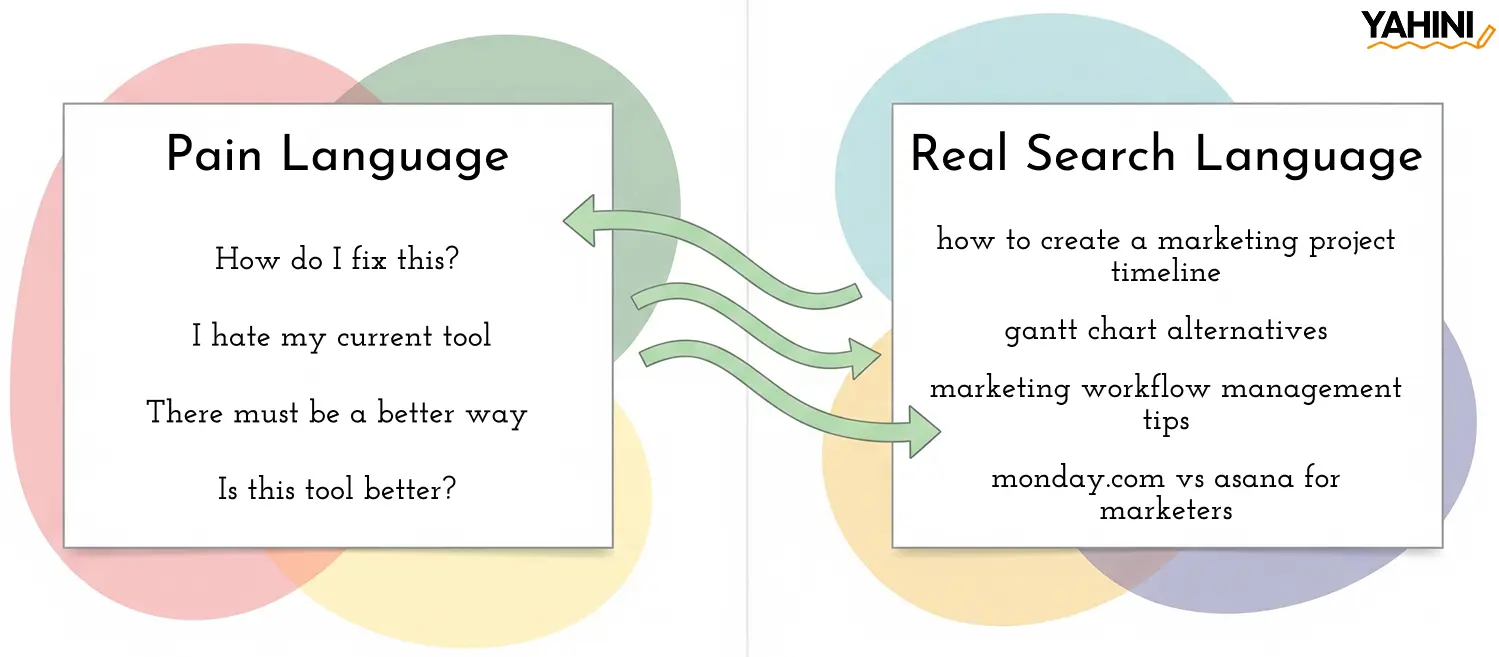
This stage of the process is where your keyword research truly begins to take shape. Your job isn’t to find new ideas from broad seed keywords, but to find the precise language your persona, Morgan, would use to describe the pains you mapped out.
This helps you find the precise language and avoid the ambiguity of broad match types that tools often suggest.
How do you find their precise language?
Start by thinking like them. For each pain point, ask yourself:
-
The "How do I fix this?" question: How would Morgan ask for a direct solution? (Example: "how to create a marketing project timeline")
-
The "I hate my current tool" search: What tool is causing her pain, and what would she look for as a replacement? (Example: "gantt chart alternatives," "excel alternatives for project management")
-
The "There must be a better way" search: How would she describe her desired outcome or a solution she's heard about? (Example: "best project management software for marketing teams", "marketing workflow management tips")
-
The "Is this tool better?" comparison: If she knows some players in the market, what would she compare? (Example: "monday.com vs asana for marketers")
This simple exercise helps you move from a business problem to a real-world search query.
You are essentially building a universe of keywords around each business problem. These detailed, specific phrases are often long-tail keywords with high conversion rates. Now you can use a tool like Ahrefs or Semrush tactically, not for initial ideas, but to validate search volume and find related long-tail variations.
Step 3: Prioritize with a multi-factor business impact score
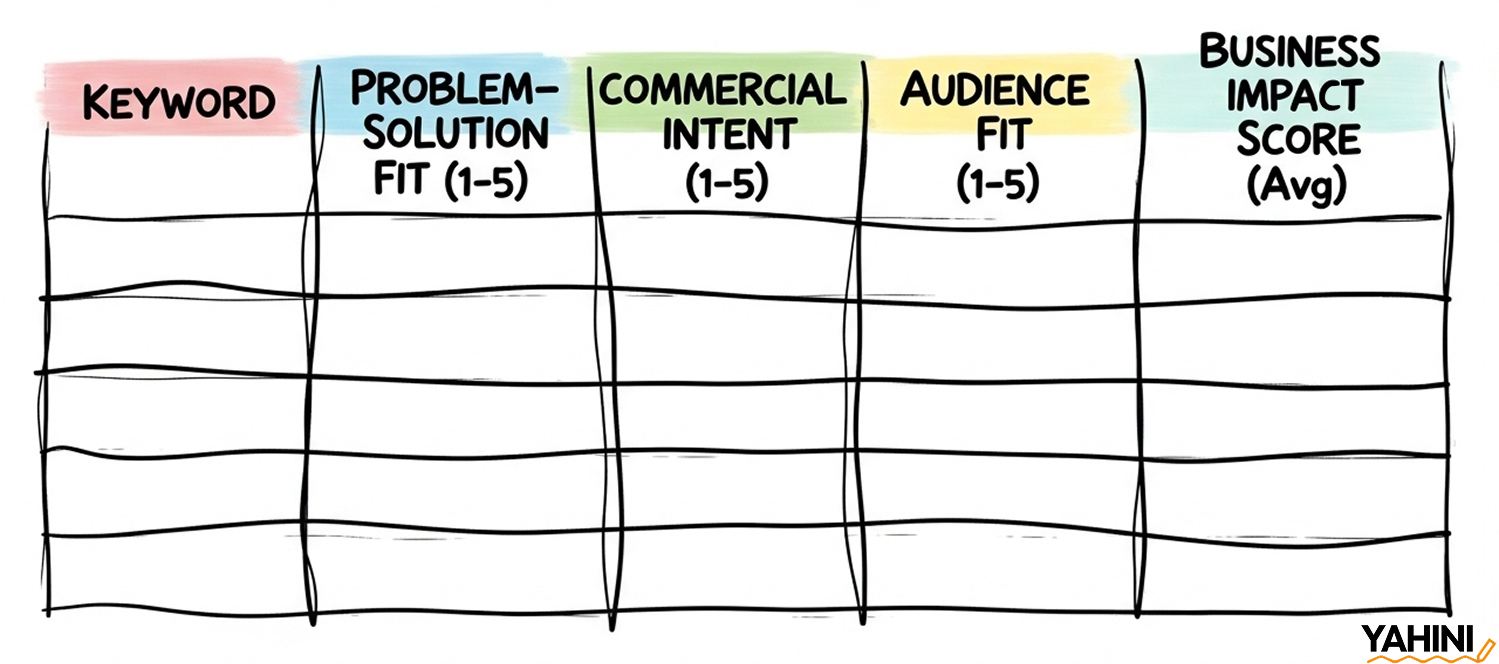
Your list of potential keywords is now strategically sound, but it's likely too long to execute all at once. You need to prioritize. This is where you apply a scoring lens that is based on your business map, not just public SEO metrics like search volume or keyword difficulty.
Let's score a few keywords for our PM tool example:
| Keyword | Problem-Solution Fit (1-5) | Commercial Intent (1-5) | Audience Fit (1-5) | Business Impact Score (Avg) |
|---|---|---|---|---|
| "best project management software for marketing teams" | 5 (Directly addresses the core problem) | 5 (Clearly looking to buy a solution) | 5 (This is exactly what Morgan would search for) | 5.0 |
| "how to streamline creative approvals" | 4 (Solves a key pain, but one step removed from the whole solution) | 3 (Looking for a solution, but might not be ready to pay yet) | 5 (This is Morgan's direct language) | 4.0 |
| "what is a gantt chart" | 1 (The problem is the alternative to this, not this itself) | 1 (Purely informational, likely a student) | 1 (Not our target persona) | 1.0 |
To make this scoring more objective, ask these questions as a team:
-
For problem-solution fit: On a scale of 1-5, how perfectly does our product solve the specific problem behind this search? (A "5" means our product is one of the best possible solutions in the world for this query).
-
For commercial intent: On a scale of 1-5, how likely is the person searching this term ready to buy a solution now? (A "5" is someone with their credit card out, like "software free trial"; a "1" is a student doing research, like "what is a gantt chart").
-
For audience fit: On a scale of 1-5, how perfectly does this keyword align with our Ideal Customer Persona? (A "5" is something only 'Morgan the Marketing Manager' would search for; a "1" could be anyone)."
As you can see, a keyword's value becomes incredibly clear through this lens. This manual scoring process is rigorous and revealing, forming the core of your keyword research.
You can absolutely do this manually, and your results will be better than the old way. But this is also where we built Yahini to be your tireless AI strategist.
Its Brand Intelligence engine runs this entire process - from mapping your business reality to analyzing thousands of potential keywords and assigning a Business Impact Score to every single one. It ensures objectivity and saves dozens of hours of manual, error-prone analysis.
Step 4: Decode SERP intent like a strategist
For your top-priority keywords, you must analyze the live SERPs. The search results are Google telling you exactly what type of content it believes the user wants and how search engines interpret a query.
Go beyond just noting "it's a blog post." Become a content strategist and decode the signals: Analyze the live SERPs, including all the SERP features like featured snippets, People Also Ask boxes, and video carousels.
First example:
-
Target Keyword: "best project management software for marketing teams"
-
SERP Analysis: The top results are all list-style articles ("7 Best...", "Top 10..."), feature comparison tables, and review site roundups (G2, Capterra). These are the dominant formats and SERP features for this query.
-
Your Content Strategy: You must create a comprehensive list-style post. To stand out, it should be framed through the lens of your persona ("The Best PM Software for Overwhelmed Marketing Managers") and include a detailed comparison table. A generic blog post will fail.
Second example:
-
Target Keyword: "how to streamline creative approvals"
-
SERP Analysis: The results are step-by-step "how-to" guides, articles with downloadable checklist templates, and a few landing pages for niche approval tools.
-
Your Content Strategy: A simple blog post isn't enough. You need to create a step-by-step guide and offer a downloadable template ("Free Creative Approval Checklist") to capture the user's information and satisfy their need for an immediate, practical tool.
This analysis makes sure that when you create content, it matches user expectations and search intent. It also helps your content compete well.
Putting your strategy into action
This is where the keyword strategy, forged in your whiteboard session, finally meets the real world. A careful and disciplined way to execute and measure separates successful content programs from those that produce 96% of pages with no traffic.
From a keyword to a high-quality content outline
Let's be brutally honest: handing a writer a keyword and a word count is not a content strategy. It's how you get generic, soulless content that ranks for nothing and converts no one, forcing the writer to guess at the keyword strategy you worked so hard to build.
A high-quality content brief is the container for your strategy. It translates all the work from your "Business Reality Map" into a set of clear, actionable instructions.
Let's build a tangible brief for our persona, Morgan, targeting the keyword "how to streamline creative approvals."
Anatomy of a high-impact content brief:
-
The strategic context (The "Why"):
- Primary Keyword: how to streamline creative approvals
- Secondary Keywords: creative workflow, marketing approval process, feedback management, proofing tools
- Target Persona: Morgan, the Marketing Manager. She feels overwhelmed, her team is missing deadlines due to chaotic feedback on creative assets, and she fears it's making her look bad to leadership.
- Business Goal: This article supports our goal of "Increase free trial sign-ups by 25%." It will attract Morgan when she's problem-aware and introduce our "Centralized Asset Approvals" feature as the logical solution.
- Funnel Stage: Top/Middle of Funnel. We are solving a problem and making her aware of a better way, with a soft call-to-action to see our tool.
-
The content instructions (The "What"):
- Core Job-to-be-Done: The reader must leave this article feeling they have a tangible, step-by-step plan to fix their broken approval process tomorrow. They should feel seen, understood, and empowered.
- Key Questions to Answer:
- Why do most creative approval processes fail? (Validate her pain)
- What are the 5 essential steps to a streamlined approval workflow? (Provide the solution)
- What's the best way to handle feedback from multiple stakeholders?
- What tools can help automate this? (Introduce our product category naturally)
- Suggested Outline (with an angle):
- H1: Sick of Email Chaos? Here’s How to Streamline Your Creative Approval Process
- H2: First, Let's Admit It: Your Current "Process" Isn't Working
- H2: The 5-Step Blueprint for a Sanity-Saving Approval Workflow
- H3: Step 1: Define Your "Approval Team" (and Stick to It)
- H3: Step 2: Create a Centralized Briefing Document
- ...etc.
- H2: The Role of Technology: Moving Beyond Spreadsheets and Email
- H2: Your Next Step: A Calmer, More Effective Approval Process
This is the kind of detail that turns a generic article into a strategic asset.
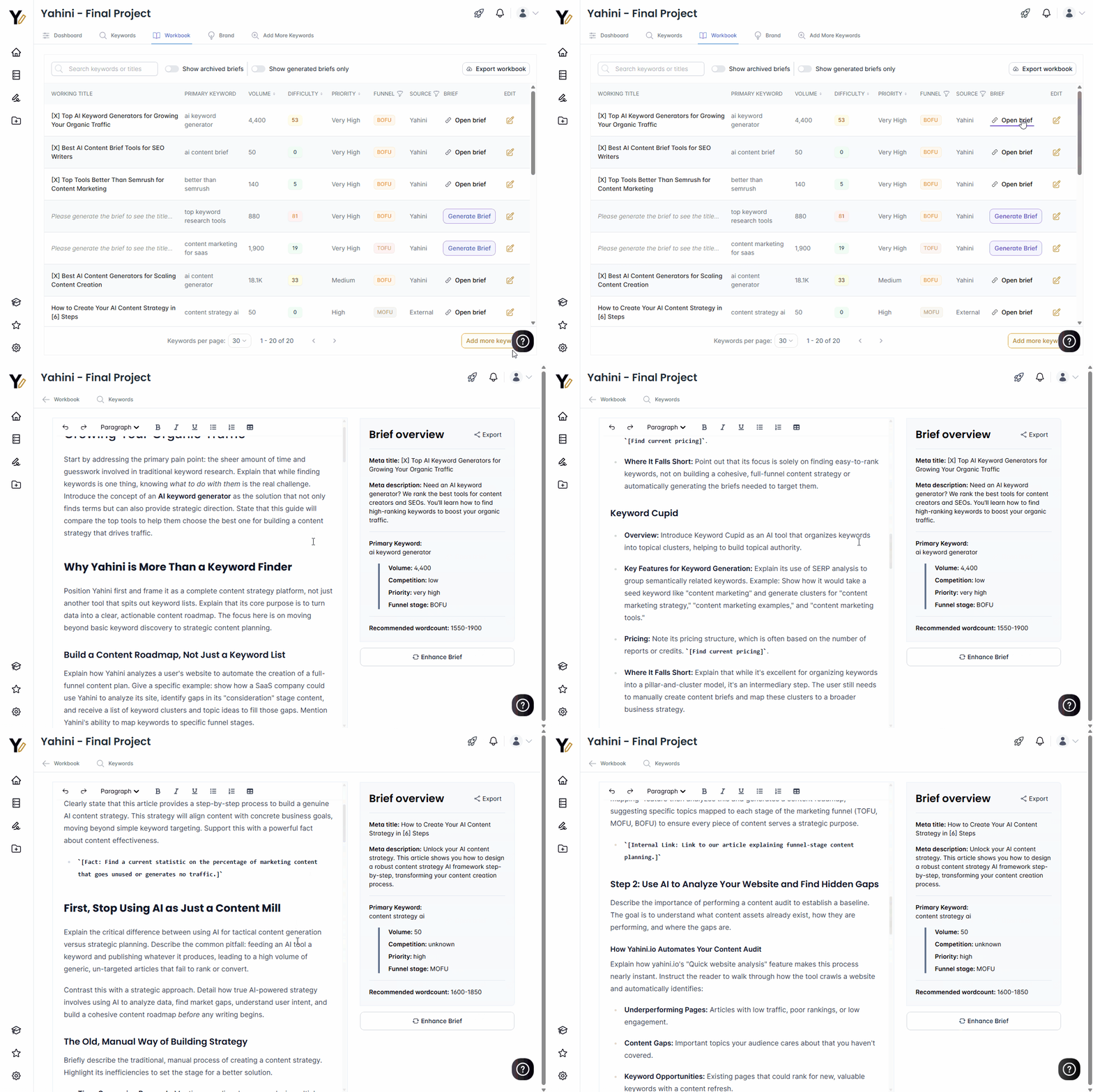
But as you can imagine, creating these briefs for every single article is a major operational bottleneck. This is another area where Yahini fundamentally changes the workflow, as it uses your Business Reality Map to create deep, on-brand, and strategic content briefs automatically. It ensures your strategy is perfectly translated every single time, without the hours of manual work.
Measure what matters with the Business Results Scorecard
Stop obsessing over rankings for their own sake.
A #1 ranking for a keyword that doesn't contribute to the business goal you defined in Step 1 is a vanity metric. It's time to measure your content against the goals of the business.
Think of your metrics in two categories:
1. Lagging indicators
These are the numbers that make your CFO smile. They tell you if the strategy is working. You need to have the analytics in place to track them.
-
Content-attributed leads: How many readers sign up for a trial during or shortly after reading a post? (Trackable in GA4 or Hubspot).
-
Pipeline generation: For high-value B2B, how many sales calls mention a key article?
-
Revenue influence: Can you connect specific articles to a closed-won deal? This is the holy grail.
2. Leading indicators
These metrics tell you if your content is on the right track to achieving the business results. They are your early warning system.
-
Clicks & on-site traffic: Are people clicking from Google? You can verify this in Search Console. More importantly, are they visiting your product or pricing pages afterward?
-
Audience engagement: Go beyond pageviews. Are Time on Page and Scroll Depth high? Are people actually reading?
-
Keyword cluster ownership: Are you gaining rankings and traffic for a whole group of related keywords? This is a sign of a successful keyword research process.
This measurement process completes the loop. The insights you gain from what's working (and what's not) should be used to refine your "Business Reality Map" for the next quarter. Your content strategy becomes a living, breathing part of your business's growth engine.
Start strategizing now
A keyword strategy that works is a business strategy first. So let's stop the frustrating chase for high-volume, low-value keywords and instead build a focused plan that targets high-intent customers and drives your specific business goals.
You now have the complete blueprint for a keyword strategy that is built on your business reality. Following this process, even manually, will put you ahead of 96% of your competitors. It is a heavy lift, but it's the right way to build a content engine that drives results. The ultimate goal is to create content that satisfies the user and the search engine alike.
For those who see the power in this framework but need to execute it with speed and precision, Yahini is the engine built for the job. It's the application of everything you just learned.
-
Need a 24/7 content strategist? See how Yahini can help you craft perfect content briefs.
-
Any questions? I’m happy to help! Just reach out!
-
Not ready yet? Learn more about Yahini here.