
8 MarketMuse Alternatives & Competitors for Content Strategy and Planning

Content Marketing Manager
I have a lot of respect for MarketMuse. For years, it’s been the undisputed champion of sophisticated content strategy. It pushes us all to think beyond single keywords and focus on building topical authority to dominate the search engines. Its content auditing and topic modeling capabilities are seriously powerful, and I’ve seen them help smart companies get a real handle on their content.
However, it’s not for everyone, and that’s okay. You’re looking for an alternative, possibly because of one of these reasons:
-
MarketMuse is expensive. I’ve seen founders of really promising, expert-led SMBs look at the pricing and it’'s a non-starter. They need a tool that can scale with them, not one that demands a huge chunk of their budget before they've even seen an ROI.
-
The workflow is a lot if you just have a specific use case. The platform is complex. I mean, it's powerful, but getting a new team member onboarded can feel like a project in itself. The workflow to get from a strategic idea to a piece of content often feels clunky and indirect. It’s not built for the speed at which most lean marketing teams have to operate.
-
What does a content score mean for a business? Too often, it doesn't translate to results. In fact, 65% of B2B sales content goes unused. This is the predictable result of a flawed content marketing strategy - articles created to chase scores and keywords, not to solve a business problem.
At the same time, many have tried using generic AI like ChatGPT to fill the gap, only to find it creates soulless, generic fluff that doesn't understand their business.
If you’re looking for an alternative to Marketmuse and you want to still please the algorithm without forgetting about the customer, check out the list below.
Table of Contents
Yahini, your AI content strategist
To be painfully clear, Yahini is not a traditional content optimization tool. There are plenty of good ones, and I'll tell you about them in a minute.
Yahini is a content strategy platform. While optimizers fine-tune, and generic AI just guesses, Yahini is a strategist. It's built to fix the strategic chaos and prompt-wrestling that come from trying to force ChatGPT to think like a marketer.
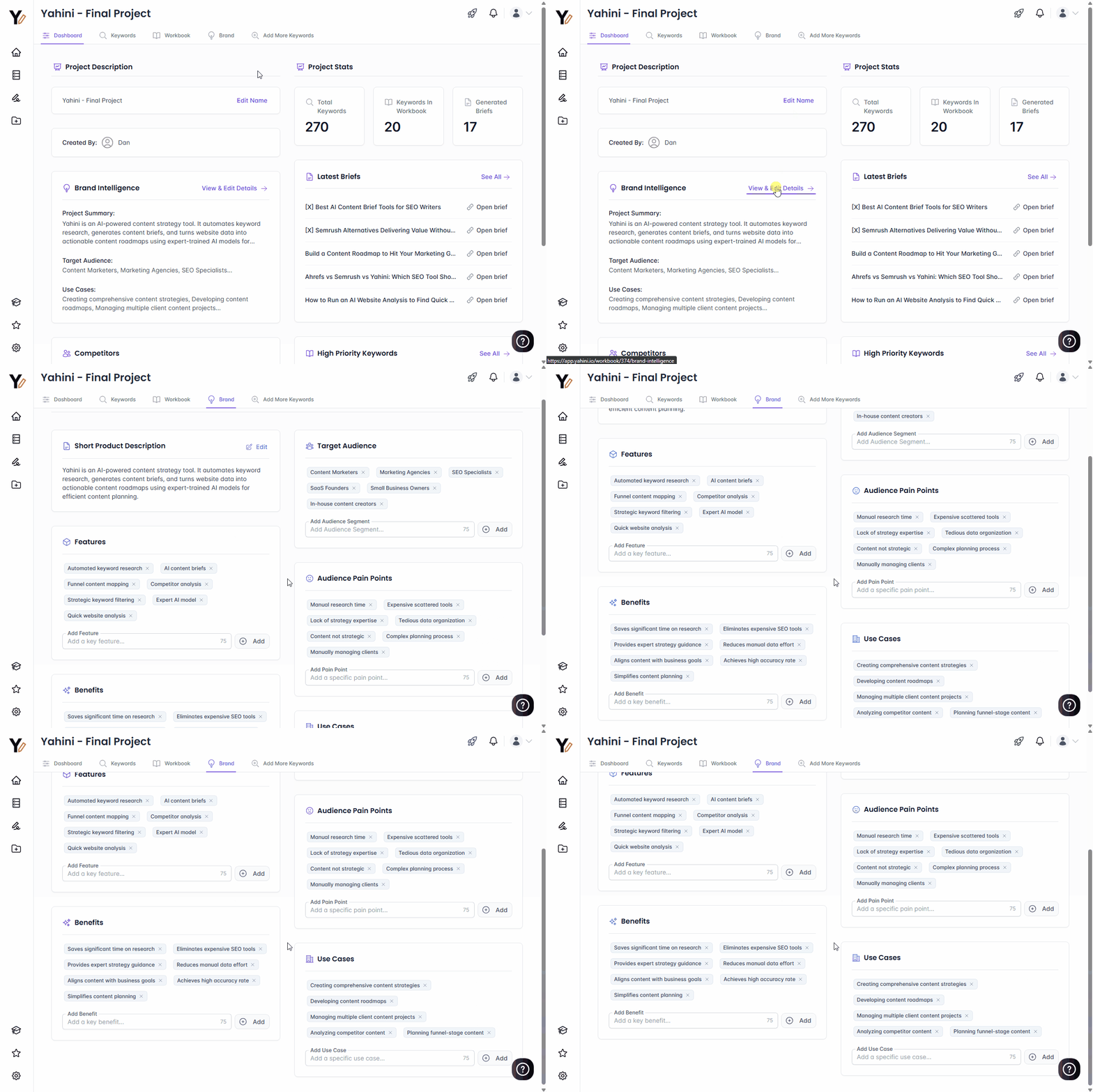
It’s built for founders and marketers tired of the strategic chaos of the content hamster wheel, and who are exhausted by the endless prompt-wrestling required to force generic AI tools to think like a strategist.
Yahini works differently because it thinks like a real strategist, combining three layers of intelligence to build your plan:
-
Your brand intelligence;
-
Live market reality;
-
Embedded expert frameworks.
Here’s how that works:
-
Automate your “Brand Intelligence”. The old way is weeks of interviews and messy spreadsheets. I hated it. The new way? Give Yahini your URL and its AI analyzes your business and builds a Brand Intelligence Hub - your single source of truth for your services, audience pain points, and brand voice. It’s the foundational strategy work that usually takes months, done in minutes. For example, if you sell project management software for agencies, the Hub will identify your key service is ‘automating client reporting’ and a major pain point is ‘wasting hours on manual spreadsheets.’ Every content idea is then built on that core business reality.
-
Prioritize by business impact. Generic keyword research lists don't know what you sell. Yahini uses its understanding of your business to prioritize topics based on their potential to drive your goals, like demo requests or trial signups. It finally answers the question, “What should we write to actually grow the business?”
-
Generate on-brand content briefs. Most AI briefs are just scraped SERP outlines that lead to generic content. It’s a huge pet peeve of mine. Because Yahini’s content briefs are born from your Brand Intelligence Hub, they’re infused with your company's strategic angles, value props, and voice from the start. It's the difference between a paint-by-numbers kit and a strategic guide for an artist.
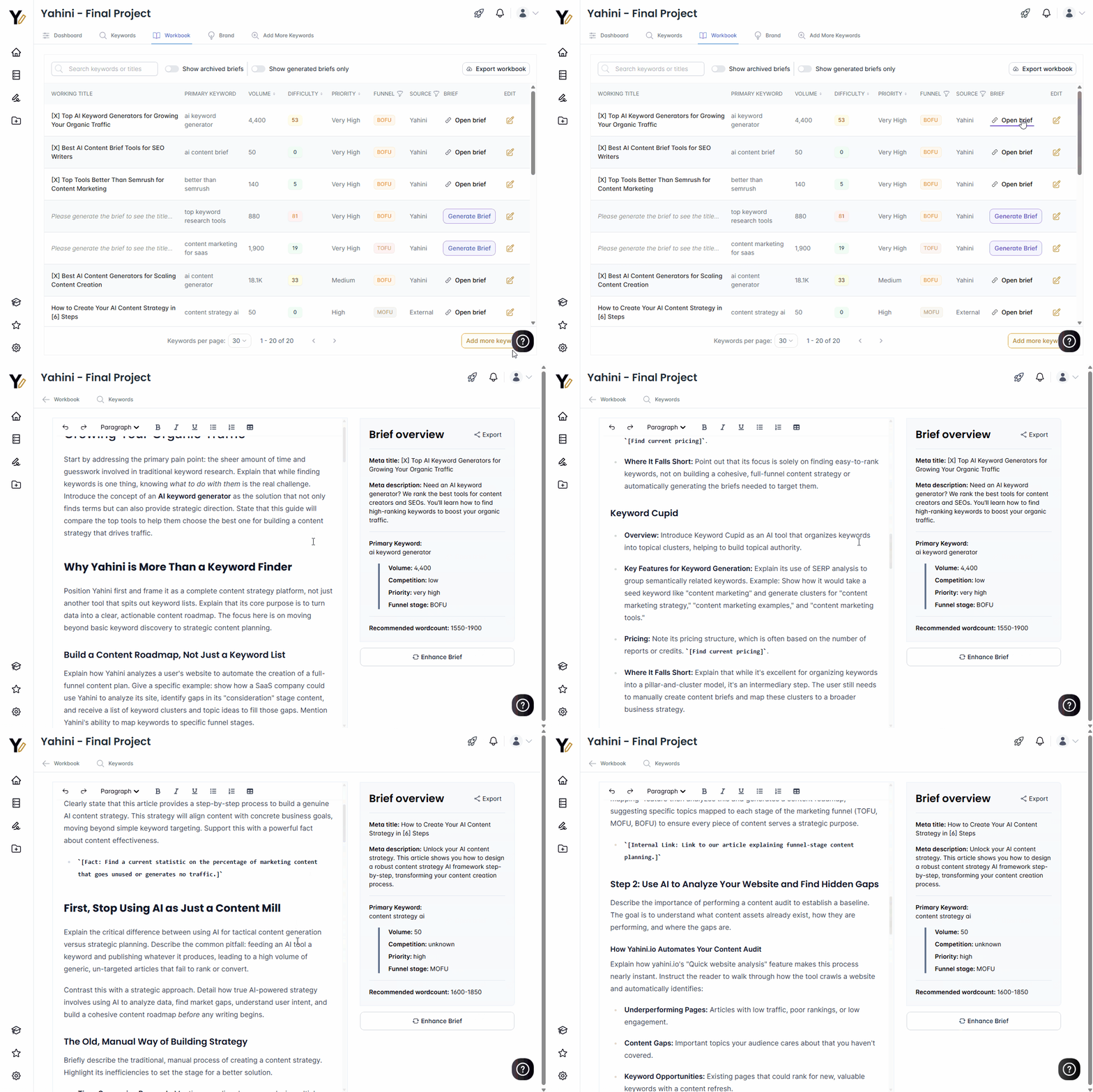
In fact, the brief for the very article you're reading was generated by Yahini. It identified 'MarketMuse alternatives' as a high-impact topic for our business and produced a detailed outline focused not on chasing keywords, but on answering the core strategic question our customers have.
Now, is Yahini the only tool you should consider? Of course not. Different content tools are built for different jobs. If you've already got your strategy dialed in and just need a best-in-class optimizer, some of these alternatives are fantastic.
Scroll down to see the breakdowns.
| Tool | Best For | Key Features | Pricing |
|---|---|---|---|
| Yahini.io | SMBs, Startups, & Agencies Needing a Goal-Oriented Content Strategy | Automated Brand Intelligence, Business Impact Scoring, On-Brand Content Briefs | Starts from $39/month |
| Clearscope | Content teams and freelancers who need to grade and optimize individual blog posts. | Report grading system (A++, B-, etc.), term-frequency analysis. | Starts at $189/month |
| Surfer SEO | SEO professionals focused on technical on-page optimization. | Content Editor, SERP Analyzer, Audit feature | Starts at $79/month |
| Frase.io | Teams looking for an all-in-one AI writing and optimization tool. | AI-powered content creation, outline builder, content optimization. | Starts at $45/month |
| Outranking.io | SEO-focused teams who want to create content that aligns with user intent. | AI-powered content briefs, SERP analysis, on-page optimization. | Starts at $19/month |
| ContentHarmony | Content marketing teams looking to streamline their briefing process. | Detailed content briefs, keyword reports, content grading. | Starts at $50/month |
| Dashword | Content teams that want a simple, easy-to-use optimization tool. | Content editor, term suggestions, content monitoring. | Starts at $99/month |
| NeuronWriter | SEO professionals and copywriters looking for an affordable optimization tool. | Content editor with NLP-based recommendations, SERP analysis. | Starts at $19/month |
Clearscope

I often describe Clearscope as the gold standard for pure, SERP-based optimization. It has a laser focus on content optimization, helping writers create incredibly comprehensive content that satisfies search intent. The tool is clean, the workflow is simple, and it does its core job exceptionally well: analyzing a target keyword and giving you a grade.
Who I think it's for
Honestly, if you have a mature content program with a strategist who is already handing you a calendar of keyword-validated topics, Clearscope is probably the best tool you can give your writers.
It's for teams who have solved the “what to write” problem and now need to perfect the “how to write it to rank” problem. For that, it’s top-tier.
What you're buying
The A++ grading system is Clearscope's signature feature. It’s simple, effective, and weirdly motivating for writers.
The editor highlights the key terms you need to include based on what's already ranking. It’s very good at what it does.
Pricing
It's a premium tool for a reason. Expect to start around $189 per month.
Surfer SEO
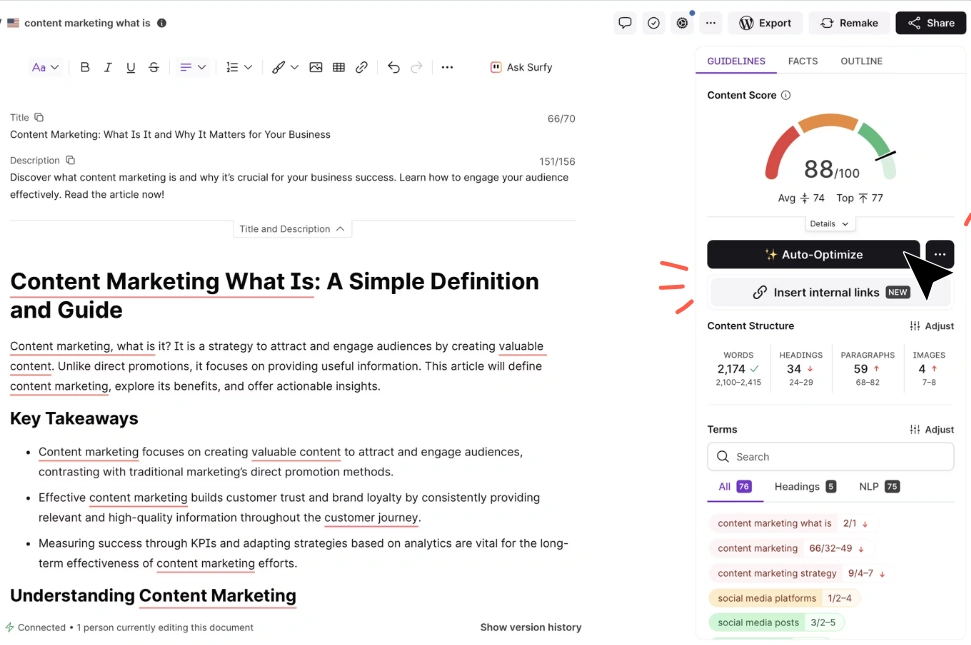
Surfer is the tool for the SEO who loves to get their hands dirty with data. It takes a “correlation SEO” approach, analyzing a ton of factors (some say 500+) to give you a deep, technical roadmap for optimization.
It feels less like a simple grader and more like a detailed diagnostic tool for reverse-engineering the top results.
Who I think it's for
I recommend Surfer to SEO professionals and agencies who geek out on the technical details.
If your process involves deep competitor analysis and you want to see all the data (keyword densities, structural elements, backlink correlations) Surfer gives you the whole playground.
Its “Audit” feature is also a killer for improving existing pages by showing you exactly what the search engine wants to see. It’s a powerful way to ensure your SEO content is technically sound.
What you're buying
You're buying a suite of powerful SEO tools.
The Content Editor is the main attraction, but the SERP Analyzer and Audit features are where the real deep SEO work gets done. It does have a “Grow Flow” feature that suggests some new keywords and internal links, but these ideas are still fundamentally based on what's already popular, not necessarily what's most valuable to your specific business.
Pricing
It’s more accessible than Clearscope, with solid plans starting around $79 per month.
Frase
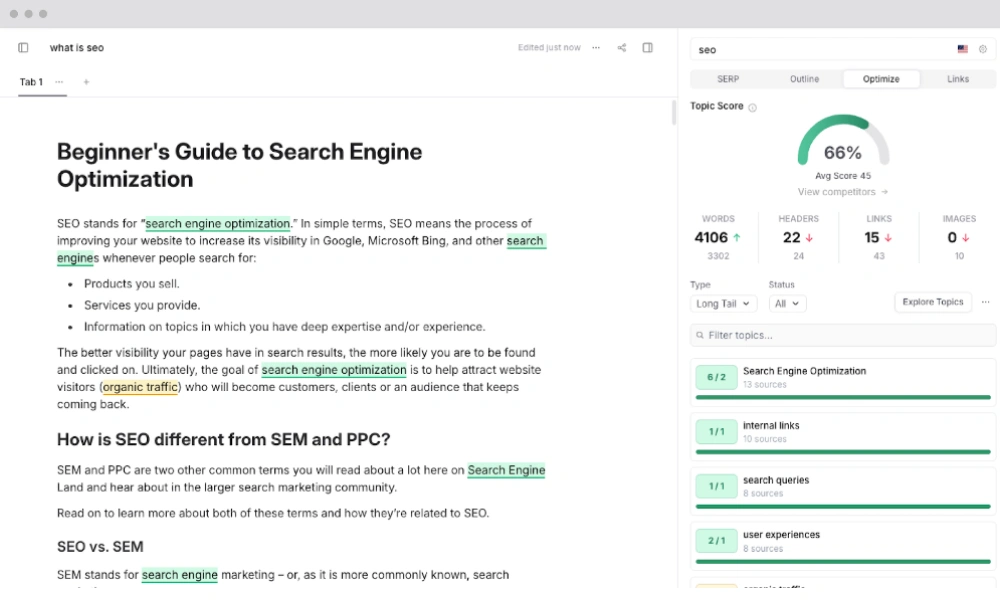
Frase (a tool that I use myself) is all about speed and efficiency. It really tries to be an all-in-one solution that takes you from a blank page to a first draft to an optimized article as quickly as possible, streamlining the content creation process.
It leans heavily on AI-assisted writing as a core part of its workflow, which makes it feel like a true writing assistant.
Who I think it's for
I've seen Frase work wonders for teams that need to produce a high volume of content without a huge headcount.
If your main bottleneck is the sheer time it takes to do research and write, Frase is designed to break that bottleneck.
It’s a very practical, get-sh*t-done kind of tool.
What you're buying
The magic of Frase is its integrated workflow.
You build content outlines from SERP headings, use the AI writer to flesh it out, and then hop over to the optimization tab to polish it up. It’s a smooth process. It also has a neat Answer Engine feature that can power a chatbot on your site, which is a unique bonus.
Pricing
This is a big part of its appeal. Plans start around $45 per month, making it a super accessible option.
Outranking
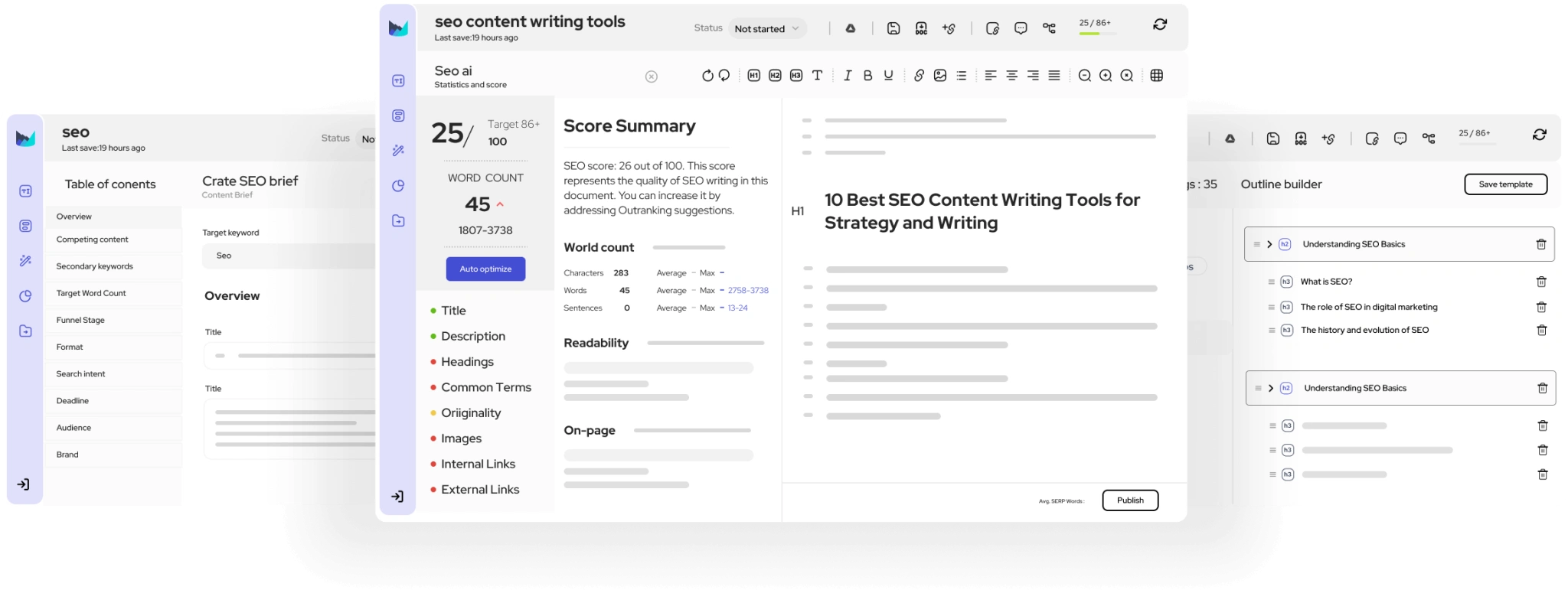
Outranking is a beast. It's a very cool platform that uses AI to go much deeper into SERP analysis and strategic content creation.
It puts a much stronger emphasis on things like factual accuracy and identifying the underlying “concepts” within the SERPs, rather than just keywords. It tries to automate more of the actual thinking.
Who I think it's for
This is a tool for serious SEO teams aiming to build big, authoritative pillar pages for highly competitive topics. If your strategy relies on creating demonstrably better, more factually dense, and more comprehensive content than anyone else, Outranking gives you the firepower to do it.
This makes it excellent for producing high-quality SEO content.
What you're buying
You're buying some serious AI assistance for content optimization. Its content briefs are incredibly detailed, and its AI writer is designed to be more factual than many others.
It tries to pull concepts and facts from SERP data to help you build your arguments. It’s an ambitious tool that aims to be a real partner in the research and writing process.
Pricing
The pricing is very accessible, with plans starting from $19 per month.
Content Harmony
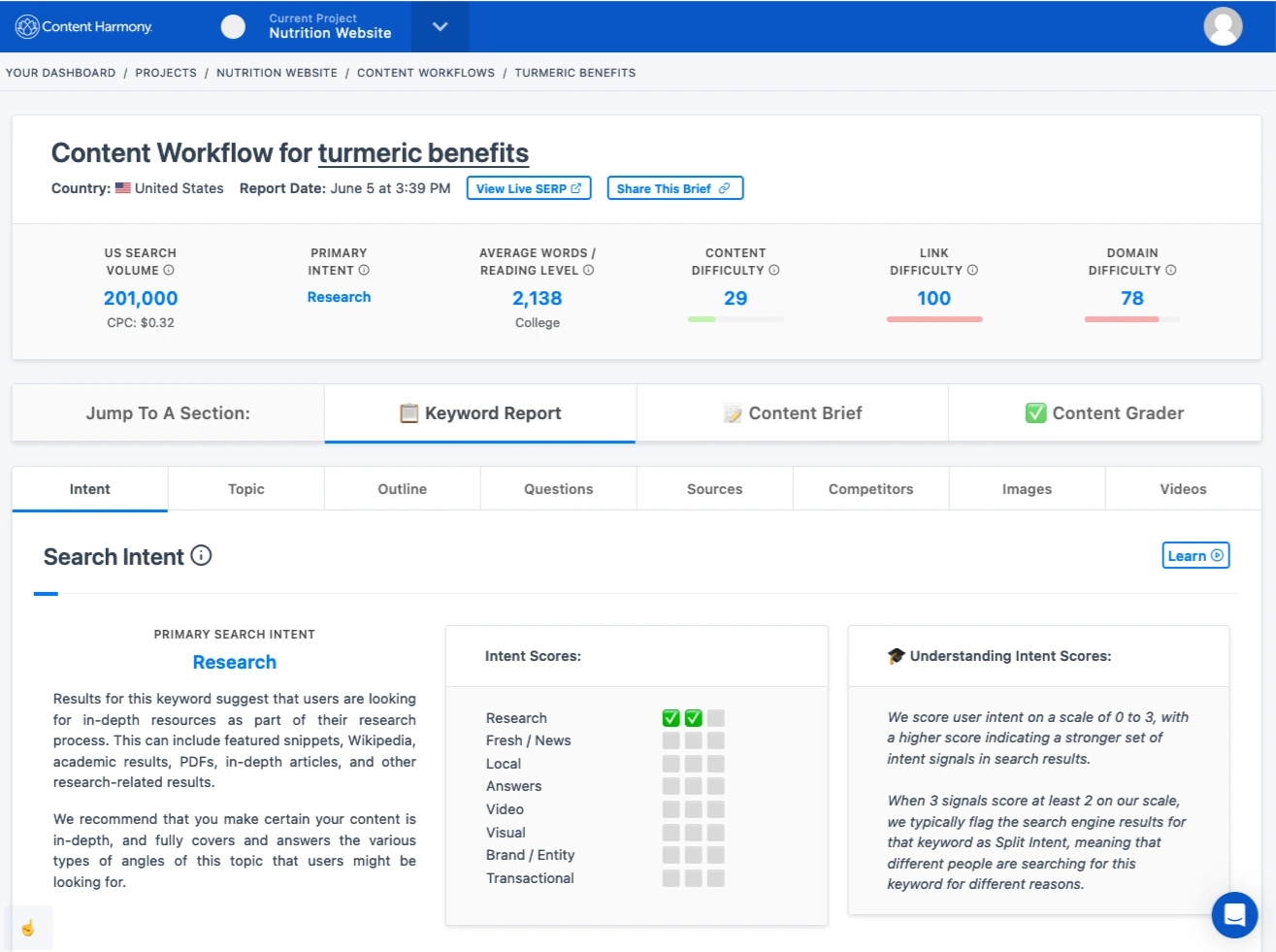
I love the philosophy behind Content Harmony. Its entire existence is dedicated to solving one of the most painful parts of the content writing process: creating a great content brief.
It’s less of a live editor and more of a workflow tool that produces insanely detailed briefs to give to your writers.
Who I think it's for
This is the tool for the Head of Content. It's for the manager who is tired of inconsistent first drafts from their team or freelancers. If your biggest headache is the endless back-and-forth that comes from poor content briefs, Content Harmony is a great option for your content creators.
What you're buying
You're buying a better process.
The detailed content briefs include competitor analysis and pull data from all over the internet, and a report, which can be exported to Google Docs, gives a writer a full picture of the search intent, audience questions, and competitor content outlines.
Pricing
It’s priced based on usage, with plans starting at $50 per month..
Dashword & NeuronWriter
I'm grouping these two because they occupy a similar, important space in the market.
Dashword offers a clean, simple, and very easy-to-use editor that's like a more streamlined Clearscope.
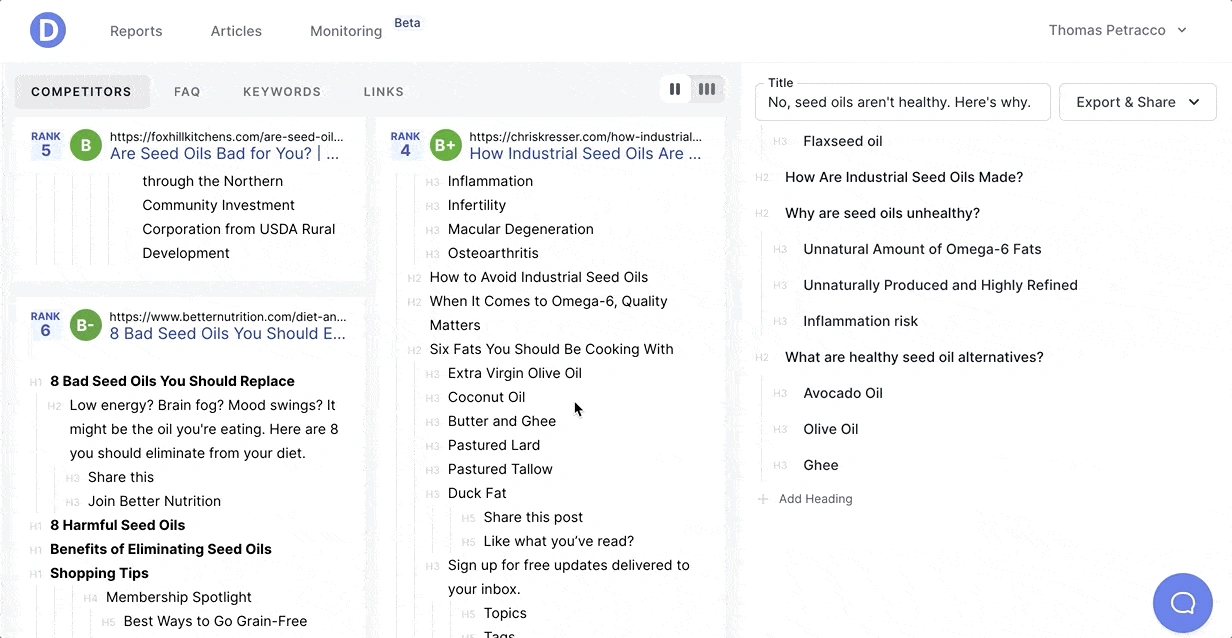
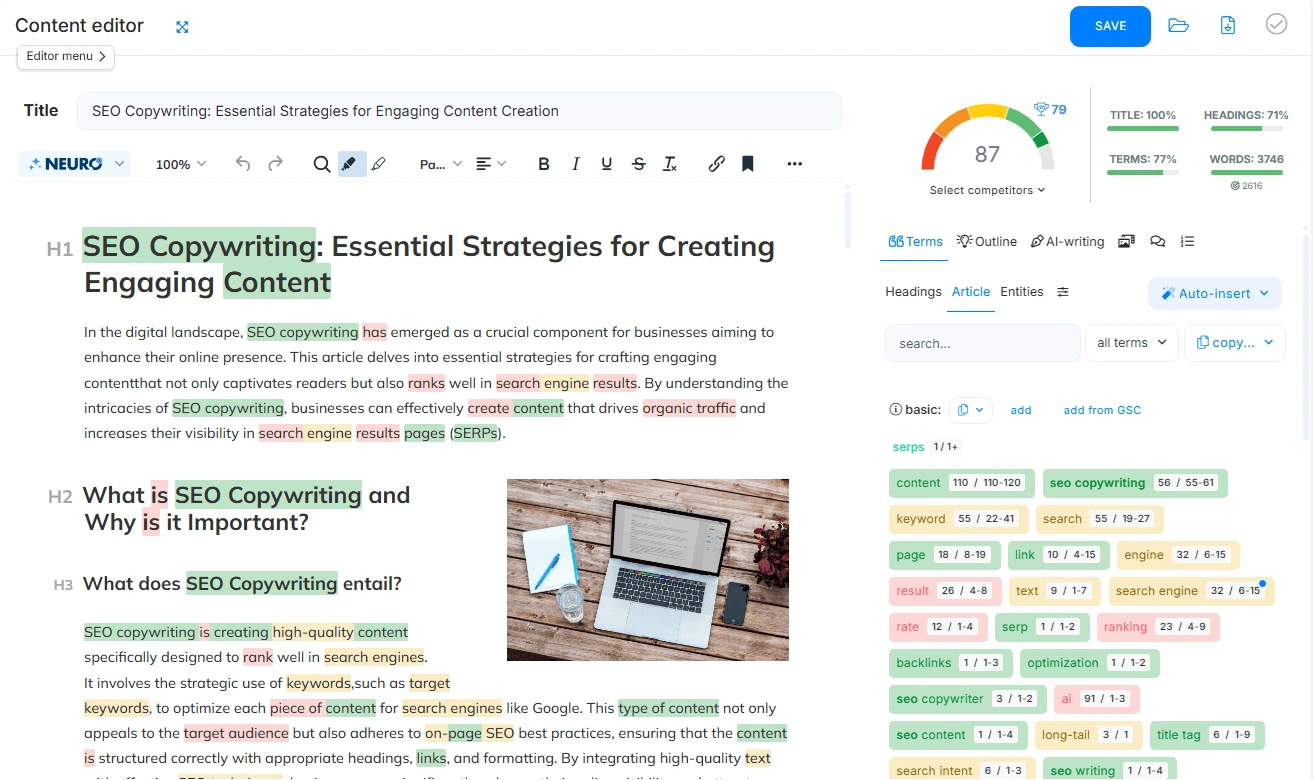
NeuronWriter is an incredibly popular, feature-rich tool that packs in NLP-based optimization, content planning, and internal linking suggestions at a shockingly low price.
Who I think they're for
Both are fantastic options for freelancers, smaller teams, and agencies who need a powerful content optimization tool without the enterprise price tag.
Dashword is for those who value simplicity and a clean UI. NeuronWriter is for those who want the absolute most bang for their buck and aren't afraid of a more complex interface with tons of features.
What you're buying
With both, you're buying a core content optimization editor with a grading system and term suggestions.
NeuronWriter just happens to bundle in more strategic-adjacent features like content planning and keyword research, making it an incredible value if you're willing to learn the system.
Dashword is more plug-and-play.
Pricing
Dashword starts at $99 per month. In contrast, NeuronWriter is famous for its affordability (and often running LTD campaigns), with plans starting as low as $19 per month.
So, how do you choose?
Okay, that's a lot of tools. Here's how I'd advise someone to make a decision. You have to be brutally honest with yourself and answer two questions.
Do you need an optimizer or a strategist?
An optimizer (like Clearscope or Surfer) is a content optimization tool that helps you make an article you've already decided to write, better. It answers, “How do I make this page rank for my target keyword?” It’s focused on pleasing the search engine algorithm for a specific query.
A strategist (like Yahini) helps you decide what articles to write in the first place to hit a business goal. This is the foundation of successful content marketing. It answers, “What should we write to increase demo signups by 15%?”
If your content marketing strategy is rock solid and you've done your keyword research, buy an optimizer. If your strategy feels like guesswork, you need a strategist first.
What’s primarily on your plate? Content metrics or business outcomes?
What are you trying to achieve?
-
Better content optimization metrics: Traffic, search engine rankings, time on page. Important, but they don't keep the lights on.
-
Business outcomes: Leads, pipeline, trial signups, revenue. This is what the business runs on.
If your job is to drive business outcomes, you need a tool that connects your work directly to them. That was the entire guiding principle behind Yahini.
A few final, honest thoughts
Changing a core tool is a big decision. Here are my straight-up answers to the questions I get most often.
What makes Yahini different from the new AI features in other tools?
It's the foundation. Most AI features are bolted onto a tool built to analyze SERPs. Yahini is a strategist-trained AI system built on a Brand Intelligence Hub.
It's grounded in your business from the start. That's how it avoids the generic, soulless fluff that other AI tools spit out.
Is Yahini good for a solo founder or small team?
Yes. I'd argue it's best for them. It automates the work of a senior content strategist, allowing a founder to delegate with confidence, knowing the strategic heavy lifting is being handled by an AI that truly understands their business.
How much manual work is still needed?
I want to be crystal clear here: Yahini.io is not a magic “write my blog for me” button.
It handles the immense, time-sucking work of research, prioritization, and briefing. This frees you up to do what only a human can: translate your expertise into powerful storytelling and nuance that connects with your customer.
Ready to build a better content strategy?
Look, you can find plenty of tools to help you chase a higher content score. But real growth, the kind that gets you promoted, comes from having a clear strategy that connects your hard work to the bottom line.
It's time to stop guessing and start strategizing.
-
Need a 24/7 content strategist? See how Yahini can help you craft perfect content briefs.
-
Any questions? I’m happy to help! Just reach out!
-
Not ready yet? Learn more about Yahini here.